Showing posts with label LTrend. Show all posts

Friday, 28 May 2021

Profiling my target group

I have chosen seven students for my target group for this year's inquiry. The group are mixed in ability and year levels. The data I have collected to be my baseline data are their PAT raw score, PAT scale score and their Reading level for Term 1 2021. Looking at the data, these students have some similarities in their data and some big differences in their achievement data for reading. 

My next step in profiling my target group will be to collect student voice. The student voice will collect how they see themselves as readers, what they struggle with in reading and also what they enjoy in reading materials and follow up activities.

I have been observing this group in my class and have identified that two of the boys are very reluctant readers, one of the girls is an ESOL learner and struggles with reading, reading materials at her year level. She is very capable of understanding concepts when unpacked with her. Two of the male students are able readers but have challenges in sitting assessments. These are all factors we will work through with this target group this year. 

My hunches so far are: 

1. My target learners will accelerate in progress if they work on self regulated strategies with the Project Based Learning programme we are now implementing in our class


2. My target learners will accelerate their progress in reading if they have a focus on creating DLOs or create activities which will represent their understanding and how they connect with reading materials


Monday, 8 March 2021

Leading discussions about our school data and planning for next actions

Today I presented my analysis of our school data to our staff. After going through the 77 page Glenbrae School Student Achievement Data Analysis Report, I was able to summarise where we are with the achievement of our students compared to the national norm and also other schools in our cluster. 

I emphasised during my presentation that numbers/data tell a story. In my years of conducting teaching as inquiries, I have grown to have a passion for collecting and analysing data. Our school data has really given me a bigger insight into the learning journeys of our students and where we as a school need to focus on to raise the achievement of our tamariki. 

I created a google document where I collated information I gathered form the tables and graphs on our school report. I also used voice recordings to discuss my questions and wonderings about what the data showed. (MOTE is the extension I used to record my voice recordings). At the end of the document I put down my wonderings and shared these with my colleagues.


During our staff discussion, a lot of great ideas and questions were discussed. As a staff we collaborated about our next learning steps. Each of us sharing our expertise. Collaboration is a wonderful tool especially when we all have the same vision. HE WAKA EKE NOA.

I also presented how to conduct a teaching as inquiry. We have a number of beginning teachers on staff this year and this presentation was of great importance to them in making the start on their own teaching as inquiry. 

At the end of my presentation, I asked our staff to write a reflection of what they were able to gain from what I presented. I feel it is vital that I gather their feedback and comments as this will enable me to help in my role to support our staff. 

Here are some of the feedback I received. 


I am very happy that I have analysed our data, I have presented to our staff and we as a staff are aware of what we need to do now. We have agreed to focus on raising the achievement of our students in Reading. We are also looking at utilising PD we have received in Oral Literacy for our Teaching as Inquiry. 

Friday, 31 July 2020

Student voice for beginning of Term 3

I wanted to find out how my students are progressing since their first student voice form. Most of the questions in the form stayed the same with the addition of some questions.

Looking at their responses, I am able to identify most of the students are more confident in expressing their reflections about their learning and writing. They are more specific with their answers. The growth in confidence is more evident in their responses.

Here are the responses on Google Slides

Thursday, 28 May 2020

Responses from my learners about their learning.

It was interesting to find out what my learners think about themselves as learners. I made the form about their learning as a whole and not just focussed in Writing. The reason for this is because, through my inquiry, I hope they will gain more confidence in other areas of their learning or use their strengths from other curriculum areas to accelerate their progress in writing. 

From reading their responses, I could also see some of them were not very confident in unpacking themselves as learners. This will be another aspect of my on going inquiry. Scaffolding my students to be self reflective in their learning. 

Below are the information from the students. Very rich data for myself for my inquiry.


Tuesday, 26 May 2020

My profiling continues with collecting student voice

I created this Google Form to collect student voice from my target group about their strengths in their learning and also to gather information about their thoughts about writing.

I recall Aaron telling us to focus on what the students' strengths and use those to maximise their learning in our inquiries. 

I am really interested to learn about what the students view as their strengths in their learning and other information this form will collect from my target students. 

Here is the Google Form:

Friday, 22 May 2020

Profiling by digging deeper

Profiling
Aaron has emphasised time and time again the importance of profiling our students before beginning our inquiries. This year I have spent a lot more time and effort in profiling my learners. I have a group of 10 students who are in my target group. My curriculum area of focus this year is in Writing. 

What I wanted to know:
I wanted to know the story of the students and their writing progress for the last five years. I wanted to find out when they made progress, accelerated in their writing or even stalled in their progress. After all the data collection I wanted to analyse what has been happening and with which teacher and year level did major changes occur. 

Data collection:
I accessed through ETAP the writing results from the year 2014-2020. I wanted the beginning, middle and end of year assessment data in Writing. The data collection itself was not as challenging as I thought once I sought assistance from the ETAP helpdesk. 

Once I printed out each year's data, I collated the information on a spreadsheet starting from 2020-2014. After doing that, I realised, if I wanted to see a trend I was actually looking at the data backwards. I should start from 2014-2020. Therefore I made a copy of the first spreadsheet and started from the year 2014-2020. See table below and 2014-2020 Writing Levels Spreadsheet


Analysis
Looking at the above table, at first I thought well its is showing some progress and some dips in progress. I also thought, it is normal for students to start in the junior school at level one and progress to levels 2, 3 and so on as they move to the senior school. I also noticed that a few of the students in my target group did not have a lot of data on our database as they joined Glenbrae School later in their primary years. To me, that does not mean their achievement is not valid or unimportant. We will have to their first assessment entries as their baseline data.

Diving deeper into the data
However, as I sat at home that night, I kept looking at the data and thinking there is more to what I am seeing on the surface. I need to dig deeper. I was actually very eager to see what the data said and I knew I had to dig deeper. I had to investigate.  Therefore, I made yet another copy of the spreadsheet and started to identify the difference between each assessment point.


With that question in mind I started comparing assessment results by comparing if there was a shift from the last assessment entry of if there was a drop. 

After doing that analysis, this is what the spreadsheet looked like. I also wrote down my notes on what I was seeing from the analysis. Refer to table below and Profiling analysis and notes spreadsheet  

What did the data tell me?
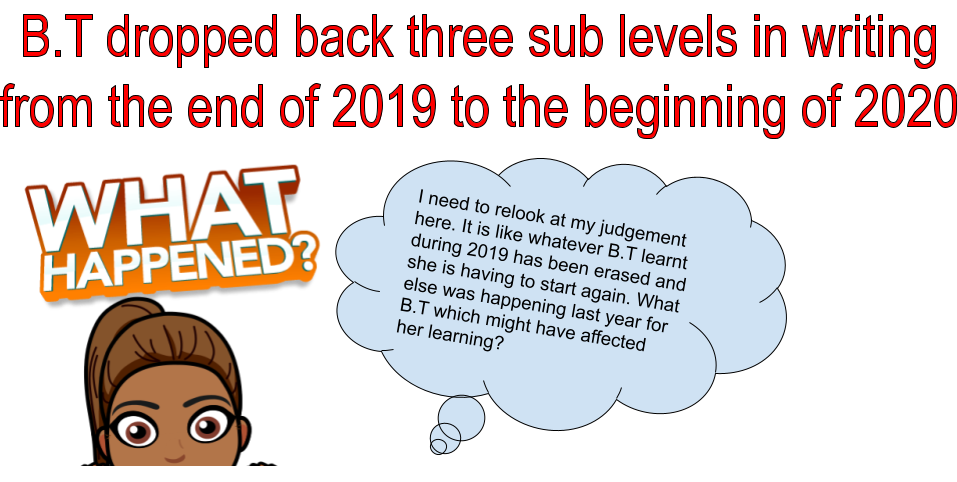
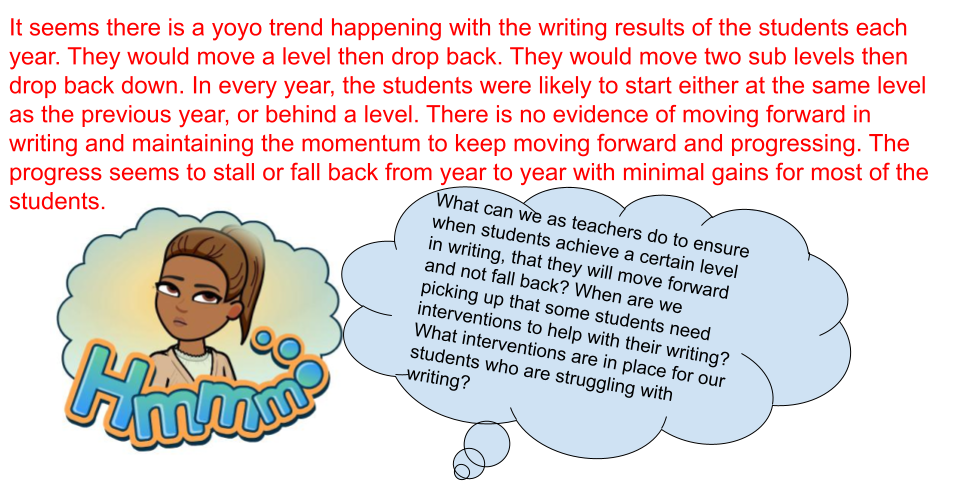
The more I studied the spreadsheet, the more I was intrigued with what I was learning. I kept thinking as I was looking at the data, "What has been happening throughout these years for my students in writing?". Below are some of the findings I found analysing the data. I still feel there are some more trends I have yet to identify.



Now what?
With that I have learnt from analysing the data, one of my goals this year is to accelerate my students in writing and ensure they do not fall back on their writing skills and results. The how will be in another blog post but I am happy I took the time to look at what has been happening with my target group with writing in the past. I also plan to share my analysis with our teaching team so we are able to unpack and discuss what the data says and the trends. I always value the input of our teaching team and I look forward to what they can bring to the discussion. It will also be good for my colleagues to do an analysis of their own target student as I find there is so much value in profiling the students. 

Where to next?
I still have to gather student voice for my baseline data. I will do that early next week. After that, it is finalising my inquiry design by looking at student voice, professional development, staff discussions and whanau voice which I have to gather next week. 


Friday, 5 July 2019

Exposure to different texts at different times

On constant reflection of my intervention I have observed changes in the quality of discussion from my students. In group discussions the students are taking more leadership and ownership of their discussions. There is also the encouragement and positive praise for the effort of other group members.

We  have been doing stock takes of our learning and have identified the shift in the texts we read and when we are exposed to reading texts. Today we as a class reflected on our journey in reading so far. We reflected on the daily opportunities for us to read during:


  • Current events reading
  • Novel reading
  • SSR 
  • Guided reading
  • Inquiry learning 
  • Reading at home
With the variety of opportunities the students have to read, it is building on their confidence in reading and also showing in their responses to texts and discussions. 


Thursday, 13 June 2019

PLG reflection

Reading through the PLG slides from the 30th of May, I have reflected on the convernor's korero and inserted a slide from his slides.
Reflection on core teaching practices when reading to learn. 
In my reading programmes the reading materials are integrated with the topic of study for the term. At Glenbrae School we have a theme for the year and through this theme we identify topics for the students to learn during the year. This year our theme is Resilience. The reading materials are always linked to the topic of study.

It is important to integrate learning materials so students are able to make connections between their reading and learning in different subject areas. Purpose for reading is very important and is always discussed and emphasised in our reading discussions.

Acquisition of language which is number eight in the convenor's core teaching practices has also been a focus of mine and has been discussed in my previous blog posts. This year, I have been focussing a lot on the acquisition of vocabulary through the guidance of Jannie van Hees. Students have been making a lot of progress in their acquisition and understanding of vocabulary. This is evident through our discussions, their response activities as well as their writing.

The eight core practices listed in the inserted slide are all very important aspects of teaching. I will also be using this slide to collaborate reading teaching practices with my colleagues.

Friday, 10 May 2019

Designing and implementing my intervention was a major focus in Term 1. This drawing illustrates what I have implemented in my teaching practice/reading programme so far. I have been reflecting on the improvements I can make and I have identified a need to look into my Learn, Create, Share pedagogy. We are fortunate in Manaiakalani as our students are equipped with tools which they can use to accelerate and access learning resources and materials which other students can not with the use of a device. Our students also have many opportunities to create work which they can use to teach others in the world about their learning.

This term, I will start accessing help from my colleagues not only within school but across the Manaiakalani cluster. In my team, I will start observing the teaching of reading and have professional discussions with my team about how we can improve the Learn, Create, Share kaupapa of Manaiakalani within our practice.

Saturday, 23 February 2019

Teaching as Inquiry focus 2019

I have been very fortunate to have the opportunity to work with Jannie van Hees not only with my class but also in professional discussions. During our learning conversations I shared my goals for my inquiry which focusses on:

- improving reading comprehension
- encouraging my students to enjoy reading
- my students gaining more understanding of the world around them through non fiction texts and current events
- my students being a ripple effect to encourage reading in their homes

Jannie also shared the value of students understanding vocabulary and in particular cluster of words in texts. I had never thought of this. Upon reflecting on what Jannie shared with me about vocabulary, I now understand the value of students having a good understanding of vocabulary and how they are presented in texts. 

Below is my inquiry focus for this year. There are so many aspects I want to cover this year with my inquiry. I am eager to see the effect this inquiry will have on my students. I also really hope it will accelerate the progress of my students in reading as well as ignite or strengthen their passion for reading.

Will daily deep diving into quality, ‘cutting edge’ texts, accompanied by ’rich’ text conversations in which all participate, and with deliberate attention to words that co-occur to carry meaning, improve students’ reading comprehension and encourage their love of reading.

Analysis of my teaching as inquiry this year

  How do mathematical practices in DMIC support learner identities in Maths? The shift in student independence in solving mathematical prob...