Profiling
Aaron has emphasised time and time again the importance of profiling our students before beginning our inquiries. This year I have spent a lot more time and effort in profiling my learners. I have a group of 10 students who are in my target group. My curriculum area of focus this year is in Writing.
What I wanted to know:
I wanted to know the story of the students and their writing progress for the last five years. I wanted to find out when they made progress, accelerated in their writing or even stalled in their progress. After all the data collection I wanted to analyse what has been happening and with which teacher and year level did major changes occur.
Data collection:
I accessed through ETAP the writing results from the year 2014-2020. I wanted the beginning, middle and end of year assessment data in Writing. The data collection itself was not as challenging as I thought once I sought assistance from the ETAP helpdesk.
Once I printed out each year's data, I collated the information on a spreadsheet starting from 2020-2014. After doing that, I realised, if I wanted to see a trend I was actually looking at the data backwards. I should start from 2014-2020. Therefore I made a copy of the first spreadsheet and started from the year 2014-2020. See table below and
2014-2020 Writing Levels Spreadsheet
Analysis
Looking at the above table, at first I thought well its is showing some progress and some dips in progress. I also thought, it is normal for students to start in the junior school at level one and progress to levels 2, 3 and so on as they move to the senior school. I also noticed that a few of the students in my target group did not have a lot of data on our database as they joined Glenbrae School later in their primary years. To me, that does not mean their achievement is not valid or unimportant. We will have to their first assessment entries as their baseline data.
Diving deeper into the data
However, as I sat at home that night, I kept looking at the data and thinking there is more to what I am seeing on the surface. I need to dig deeper. I was actually very eager to see what the data said and I knew I had to dig deeper. I had to investigate. Therefore, I made yet another copy of the spreadsheet and started to identify the difference between each assessment point.
With that question in mind I started comparing assessment results by comparing if there was a shift from the last assessment entry of if there was a drop.
After doing that analysis, this is what the spreadsheet looked like. I also wrote down my notes on what I was seeing from the analysis. Refer to table below and
Profiling analysis and notes spreadsheet
What did the data tell me?
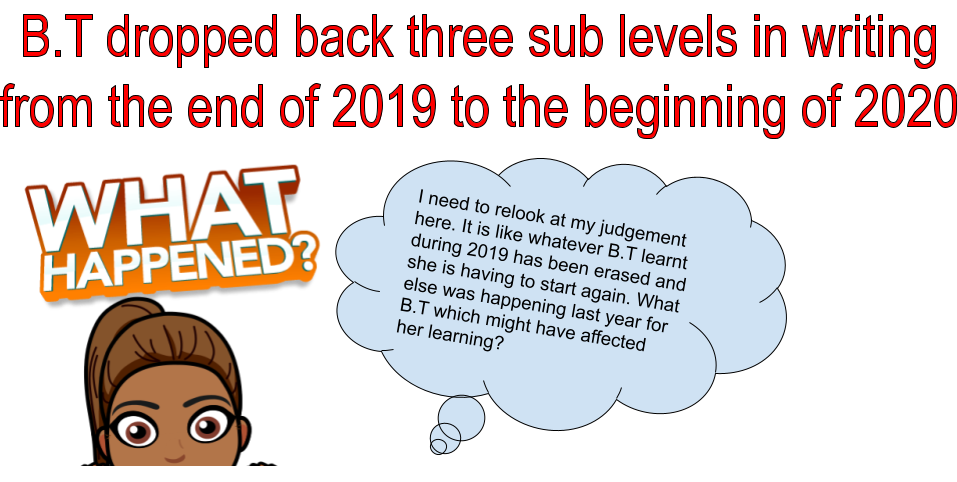
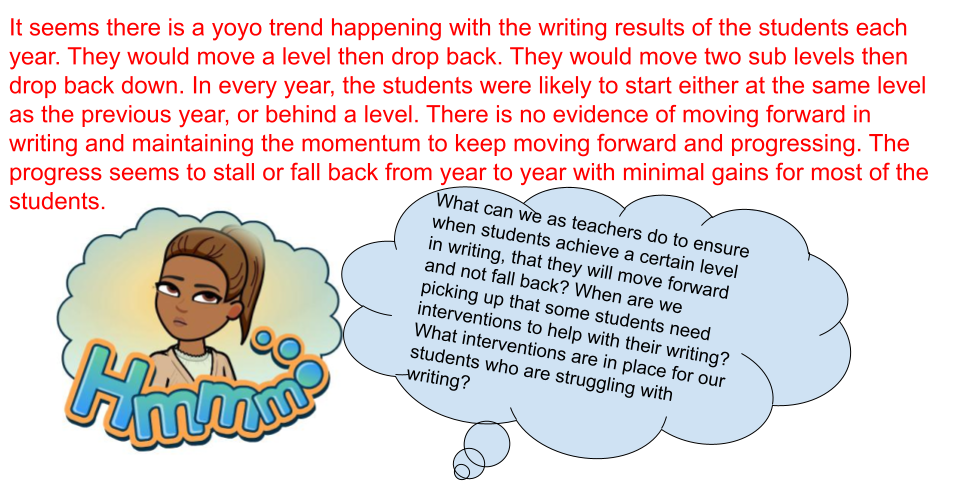
The more I studied the spreadsheet, the more I was intrigued with what I was learning. I kept thinking as I was looking at the data, "What has been happening throughout these years for my students in writing?". Below are some of the findings I found analysing the data. I still feel there are some more trends I have yet to identify.

 Now what?
With that I have learnt from analysing the data, one of my goals this year is to accelerate my students in writing and ensure they do not fall back on their writing skills and results. The how will be in another blog post but I am happy I took the time to look at what has been happening with my target group with writing in the past. I also plan to share my analysis with our teaching team so we are able to unpack and discuss what the data says and the trends. I always value the input of our teaching team and I look forward to what they can bring to the discussion. It will also be good for my colleagues to do an analysis of their own target student as I find there is so much value in profiling the students.
Where to next?
I still have to gather student voice for my baseline data. I will do that early next week. After that, it is finalising my inquiry design by looking at student voice, professional development, staff discussions and whanau voice which I have to gather next week.


