Talofa lava. As we embark on another exciting year I would like to take this opportunity to introduce myself. I look forward to working with our schools in our cluster this year. Wishing you all a successful year ahead.
Wednesday, 15 February 2023

Friday, 16 December 2022
2022 TAI evaluation
My teaching as inquiry for this year has brought me so much more experience as a an educator and leader. Working with my sample group of teachers enabled me to gain insight about the challenges and successes a team of teachers can experience when collaborating as a team on a specific goal.


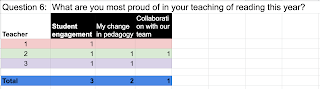


Our goal as a group was to accelerate the learning of our akonga in reading. We also wanted to change the way we teach so we were all on the same understanding as to what an effective reading programme is. It is fair to say we have not completely achieved the goal of identifying what an effective reading programme looks like in the classroom but we have certainly made a good start.
What happened this year?
Collaborative planning - we had a lot of korero/talanoa about our understanding of what an effective reading programme is. What we currently do in our practice which works and what we could add
Using the Planning Fala (Manaiakalani Effective Reading Practices Survey (2022). Analysis of teacher responses by N. Rosedale (Literacy Facilitator) for the Reading Design Group) - this was a core element of my teaching as inquiry. The Planning Fala incorporated aspects of a reading programme which I wanted to incorporate into my teaching as inquiry and much more. We have added certain parts of the Planning Fala to our planning and teaching but need to incorporate more next year.
Interpreting assessment data - as part of my teaching as inquiry, I interpreted the PAT reading data for our senior school from the term one assessment and also analysed the term four data. I strongly believe data is an integral part of any teaching as inquiry. As a teacher, data can inform our practice and challenge us to make changes or to keep doing what we are doing if the data shows acceleration. The qualitative data I collected from my sample group gave me a lot of insight about the strengths and needs of the teachers I worked with this year.
In class observations - as part of my inquiry, I also observed teachers in their classrooms teaching their own target learners. From the beginning of my intervention, I highlighted that my role was to work alongside our group. The observations were for teachers to receive feedback and feedforward through post discussions about their teaching practice in reading. I do understand that observations can be daunting for some teachers but I relied on our connections as teachers, team members and friends to eliminate this feeling.
End of year data collection
My data set for the end of my teaching for inquiry for this year is a survey completed by my sample group in Term 4. The survey was sent in a google form and I have analysed the data using the qual analysis method Naomi Rosedale taught me.


Friday, 18 November 2022
Qual analysis of my point 1 data collection
At the beginning of my intervention, I collected qualitative data from my sample group. There were no numerical information from the data set because it was a survey where the teachers answered the questions. In a recent PLG, Naomi Rosedale discussed analysing qualitative data in a quantitative way. This is called qual analysis. I asked Naomi if I could meet with her so she could go over this analysis technique with me.
The meeting with Naomi was a very educational meeting for me because in the short time we met, I learnt so much from Naomi about how to analyse qualitative data. The analysis I have done of my data set is a very basic qual analysis. Naomi has shown me some other forms of qual analysis to analyse qualitative data but for a start, this is what I have done.
This method of data analysis paints a much clearer picture of qualitative data. When I looked at my original data analysis in qualitative form, there were so many different information presented. However, when I completed the qual analysis of the same data set, I could clearly see some common trends in the data set. I suppose it supports a saying I have about quantitative data - the numbers tell a story.
The overall theme I picked out from my data analysis were:
- There was and is still a great need for pedagogical knowledge needed for our teachers to plan and implement an effective reading programme
- The teachers all had different ideas about how to teach reading
- There was no common understanding of how to plan and teach reading
- There is a lack of connection with whanau with the reading programmes happening in classes
- Key elements highlighted in the Fala Planning Model were not used in our current reading programmes
I have just collected the last data set from my sample group from their reflections of our journey this year. I will do a qual analysis of this data set and post it in an upcoming blog post.


Friday, 21 October 2022
Evaluating data for inquiries
Today's PLG for our CoL teachers focussed on how we analyse data. There were definitely a lot of great learning which I took away from the PLG.
I have always thought about collecting data as qualitative and quantitative. Quantitative giving more statistical information with numerical values and qualitative where the information is more categorial. Today Naomi Rosedale did share that there are ways to analyse qualitative data to give more numerical information. I am booking a time to meet with her so she can give me more support in doing this.
Data is really important in our teaching as inquiry. Whenever I analyse students data, there are always so many questions and wondering which come to mind when looking at data especially over a number of years. I always say that data tell a story about what is happening for our students and also our teaching as teachers.
This year, because my sample group are our teachers, I have collected my profiling data using surveys and also quantitative data from the assessments of the target students in each teachers' group. As we are heading towards end of year assessments, I am very keen to see what the summative data will show in the students' assessments and also the end of year qualitative data from my sample group of teachers.
"Just saying they have made progress because they have a higher test score or jumped xxx levels is not enough.
Need to compare to something more than just pre and post test data.
Are the learners in your target group making progress in comparison to... Norm, Data from last year, other comparative learners in school/cluster?" (PLG slide 63)
The information above from our PLG slides highlights the importance of comparing the achievement of our students to the norm, past data and also learners in other schools and clusters. I think this is important because if we just compare our students by themselves, then we will not know how they are achieving compared to other learners in the cluster or NZ.

The template above from our PLG slides is one way we can compare our student data with the norm and a comparison group.
Wednesday, 14 September 2022
Deep learning conversations about planning for purposeful learning drawing on the Reading Planning Fala
Vocabulary
Through the learn activities, there is a focus on vocabulary in the texts. There is a shift in the student discussions where students are often questioning the meaning of words they come across in their texts. The students are also experimenting with using these words in their everyday conversations. Some of the activities around vocabulary are identifying how the words are used in the text. What about the text type, sentence, paragraph helps us predict what the word means? The students are now consciously using these strategies to predict the meaning of words they do not understand.
Text selection
In a meeting with my sample group of teachers, we discussed the topic of text selection for learning. In the Reading Planning FALA, it states to have a specific text selection for a rich set of texts. We unpacked what this might look like as we select texts for our planning.
- Multimodal - comics/graphic novels, picture books, newspapers, brochures, print advertisements, posters, storyboards, digital slide presentations
- Caters for the learning intention - does the text support the lessons purpose for students to achieve the Learning Intention of the unit?
- Texts which are challenging and fosters perseverance of reading - are the texts challenging for the students? Do they enable the students to struggle with the text and seek clarification through rich discussions?
- Information/topic specific - do the texts relate to the topic of study? Enables wide and narrow reading for information?
- Main, supporting, challenge text - Will two texts support each other and the challenge text encouraging the students to compare and contrast information from the texts and making their own conclusions?
- Student choice in text selection - Will the students have opportunities to seek more texts of their own choice which links to the unit of study?
- Vocabulary - texts introduces students to new vocabulary
There are so many aspects to think about with text selection but when teachers are purposeful in their text selection, the learning will be more purposeful, challenging and enjoyable for the students.
Extended discussions
For years, our school have focussed on having rich discussions during learning. In Maths with the use of TALK MOVES to facilitate discussions. In reading, a focus on having dialogic discussions. Yet, I still feel and observe that our students are reliant on us as teachers to lead discussions and prompt them. I have seen and experienced some excellent discussions where the students have been so involved in their discussions that it almost sounded like a heated debate about the topic. I did reflect after those lessons if it was the topic the students were passionate about or the texts or set up of the lesson. I believe purposeful discussions have to be planned for and that comes from the teacher knowing the focus of the unit of learning, the lesson and understanding the texts and where to focus the discussion for extended discussions.
Reflection
It is great to be engaged in these learning conversations with my colleagues because it not only highlights what we need to work on but also empowers each of us to change our mindset and try new ideas in our planning and teaching. I feel we have definitely shifted in our understanding of how to plan and teach reading and it is still a work in progress but the shift in understanding is definitely evident from our professional discussions.
Thursday, 8 September 2022
AKo, Hanga, Tohatoha
Learn, Create, Share
Ako, Hanga, Tohatoha

Having shorter inquiry units linked with literacy has been so successful in my class. Where before, we would drag a unit for a whole term, now we have a long term inquiry topic but choose different lines (aspects) of inquiry to focus on for 4-5 weeks. I found the students enjoyed the shorter and focussed progress of learning. I also feel the two weeks of front loading and exploring the topic using the materials I prepared led the way for the students to choose their own inquiry topics.

The searching for information was a learning process the students are confident in. Support is still needed for some students to identify what relevant sources of information are and to translate information they read into their own understanding. This is an ongoing need as students are using digital sources of information for their learning. Thus highlighting the importance of being cybersmart.


Friday, 26 August 2022
PLG reflection
Yesterday at our CoL PLG, I was in a small group discussion where I shared where I am so far with my inquiry.
The focus of my inquiry this year is to work with a team of teachers in my school to plan a reading programme which aligns with the Manaiakalani Reading Plan FALA.
As a team, the teachers in my inquiry group and I have been constantly discussing what and how we will change our reading practice to cater for not only our inquiry groups but all our students. I think it is very important to highlight that, if we intend to make a change in the way students learn, then we as teachers have to make the change first.
From my teaching as inquiry this year, these are the changes we have made so far:
- At our team meetings we have a time set aside to share our planning for our literacy programmes and our inquiry programme as they are integrated
- We have time set aside in our team meetings to reflect and share what we are doing for our own teaching as inquiry
- We are working on using the same planning templates for our reading programmes
- We are consistently sharing resources which we can use in our classes
TWEAKING!!!!
I made the above templates to be used for our short term planning. These templates are to be used with the incorporation the T Shaped literacy in having a main text, support text and a challenge text. HOWEVER!!!!!! We have found that although the reading planning is very detailed, it is not very practical for a teacher to be spending so much time on doing the planning using this template for three reading groups per fortnight. We are now on a quest to simplify, modify or re-create a template for our short term planning for reading. A planning template that still encompasses what we want to have in our reading programme but is not too time consuming. That meeting will happen next Monday in our team meeting.
Another way I am monitoring my teaching as inquiry, is by looking at the class sites of our teaching team. By looking at what is on the site, I am able to make a link between what we are implementing from my teaching as inquiry and how this is translated to the learning of the students. I also make copies of the slides used for student work, make a copy then add comments and feedback. Some of the feedback I have given is around texts being used for students learning being at the right level of challenge for them. I have observed that when texts are too complicated for the students, the learning conversation is predominantly controlled by the teacher. We have also discussed as a team the idea of giving the students the texts at the end of the week so they are able to read at home during the weekend and have some exposure to the text by the time they start the next week.
As well as formal meetings, we also have informal conversations about what we are doing in our reading programmes. We often discuss what we observe in our students' learning and what we find works and what doesn't. It is good that we are consistently sharing our pedagogical journey with each other.
I will be collecting my next set of data from my inquiry group in the next week. Although I feel like we have not done enough to show any major changes in student learning, it is till good to gain an idea of where the teachers are currently at with their practice and reflections.
Subscribe to:
Posts (Atom)
Analysis of my teaching as inquiry this year
How do mathematical practices in DMIC support learner identities in Maths? The shift in student independence in solving mathematical prob...
-
Talofa lava. As we embark on another exciting year I would like to take this opportunity to introduce myself. I look forward to working with...
-
When we signed up for Tuhi Mai, Tuhi Atu this year, I thought a lot about how we could make it work for our class. I then came up with an i...
-
How do mathematical practices in DMIC support learner identities in Maths? The shift in student independence in solving mathematical prob...
